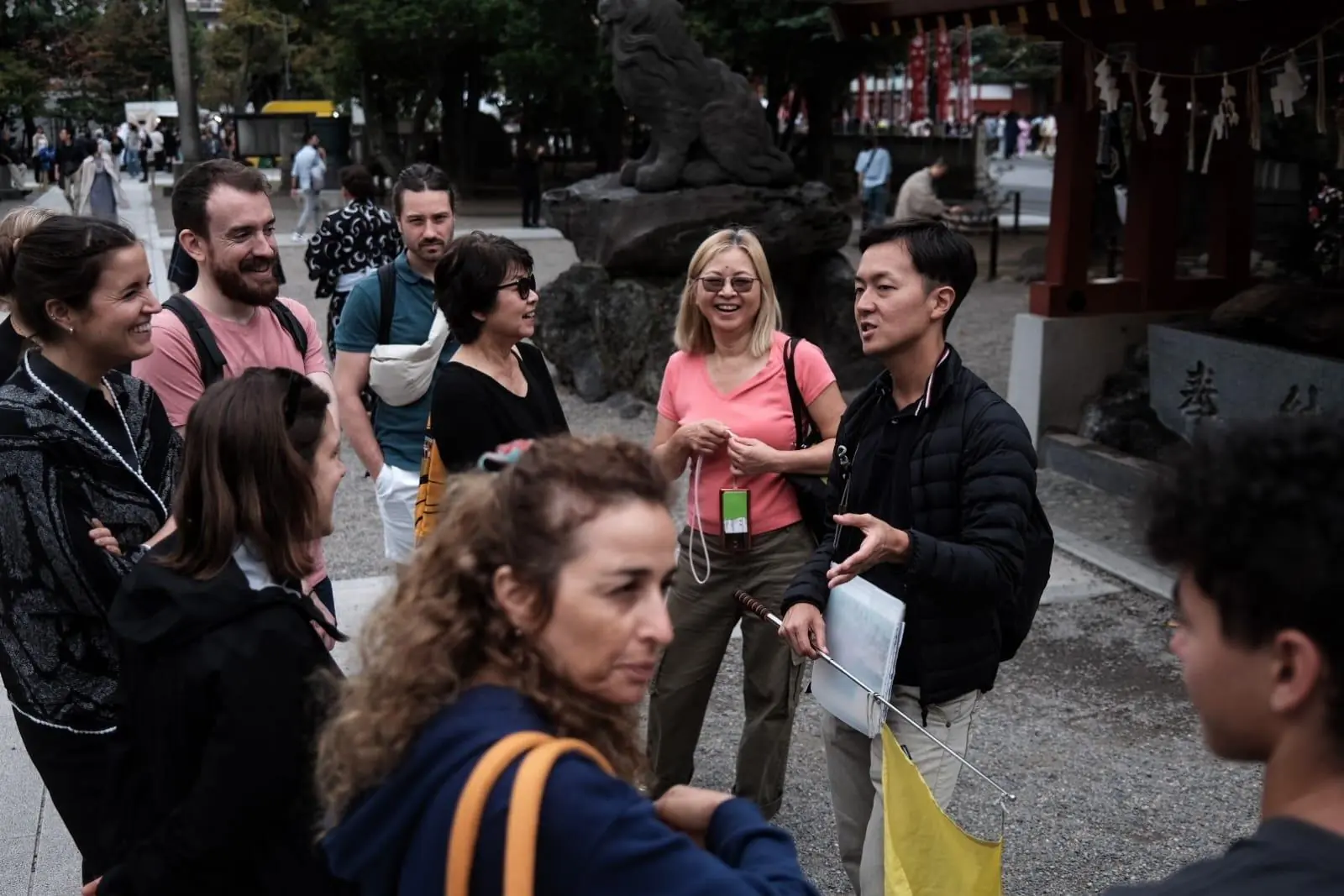
Let me be honest upfront: Tokyo is one of the safest, most well-organized cities in the world. Signs are increasingly in English, Google Maps works perfectly, and you can absolutely explore on your own and have an amazing time.
So why would you hire a tour guide in Tokyo at all? Is hiring an English-speaking guide actually necessary, or just a nice-to-have?
Having guided over 500 tours in Tokyo, I've seen exactly when it's worth hiring a tour guide and when travelers are perfectly fine on their own. This isn't a sales pitch. It's an honest breakdown from someone who has seen both sides, so you can make the right decision for your trip.
I believe that the best travel decisions come from honest information, not pressure. If you read this article and decide you don't need a guide, that's a perfectly valid choice. Tokyo will still be amazing.
When a Guide Is Worth It
First-Time Visitors Who Want Depth, Not Just Selfies
Tokyo can be overwhelming on your first visit. Not because it's difficult to navigate (it isn't), but because there's so much happening beneath the surface that you can't see. A temple isn't just a building; it's a living piece of history with rituals, symbolism, and community roles that aren't written on the information boards.
On my Asakusa tour, for example, I don't just point out Senso-ji Temple. I explain why the gate guardians look fierce, what the incense ritual means, and why the fortune papers tied to the racks might actually be "bad luck" fortunes that visitors are leaving behind. These layers of meaning transform sightseeing into understanding.
First-time visitors consistently tell me that the cultural context changes everything. It's the difference between "I saw a temple" and "I understood why this temple has been the spiritual heart of this neighborhood for 1,400 years."
Travelers with Limited Time
If you have 2-3 days in Tokyo (which is common for business travelers or those on a multi-city Japan trip), every hour matters. A guide eliminates the time you'd spend figuring out train routes, walking in the wrong direction, and standing in front of a menu you can't read.
More importantly, a guide knows the rhythm of the city. I know which attractions to hit first to avoid crowds, when certain shops and markets are at their best, and which "must-sees" can be experienced quickly versus which ones deserve an hour of your time. This kind of real-time optimization can easily save you 2-3 hours over the course of a day.
Families with Children
Traveling with kids in Tokyo is wonderful but requires pace management. Children get tired, hungry, and bored at different times than adults. A guide adjusts the route in real-time. We know where the nearest restrooms are, which temples have spaces for kids to run, and how to keep younger travelers engaged with stories and interactive elements.
Our routes are mostly flat and pram-friendly. We regularly welcome families with children of all ages, and I've developed storytelling techniques that keep kids fascinated while still giving adults the cultural depth they're looking for.
Special Interest Travelers
If you're passionate about Japanese history, architecture, food, photography, or pop culture, a guide can take you far deeper than any guidebook. I adjust every tour based on what excites each guest. A photographer gets taken to the best light and composition spots. A history buff gets the full backstory of every landmark. A food lover gets taken to the places locals actually eat.
This level of personalization is impossible with a group tour or an audioguide. It comes from reading the guest's reactions and having deep enough knowledge to pivot the conversation in real-time.
Day Trip Explorers
Day trips to Kamakura, Hakone, and Nikko involve complex transport systems, multiple connections, and destinations that are much less English-friendly than central Tokyo. Hakone alone involves trains, cable cars, ropeways, boats, and buses, all operated by different companies with different passes and schedules.
A guide handles all the logistics so you can focus on the experience. They also adjust the itinerary based on weather (crucial for Mt. Fuji views in Hakone) and crowds. For day trips, the value of a guide is often highest because the time savings and logistical relief are most significant.
When You Might Not Need a Guide
I believe in being transparent: a guide isn't right for everyone, and overselling would do a disservice to both you and me.
Repeat Visitors Who Know the Basics
If you've been to Tokyo before and already have a feel for the train system, cultural norms, and general geography, you may not need a guide for the main attractions. That said, even repeat visitors often book a guide for specific interests: a deep-dive into a neighborhood they haven't explored, or a day trip they're unfamiliar with. But for revisiting your favorite spots? You've got this.
Independent Explorers Who Love Getting Lost
Some of the best travel experiences come from wandering without a plan: discovering a tiny ramen shop in a back alley, stumbling into a local festival, or getting lost in a neighborhood you've never heard of. If this is your travel style, a structured guided tour might feel constraining. Tokyo is incredibly safe for wandering, even at night, and the serendipity of unplanned discovery is genuinely one of the joys of visiting Japan.
Budget-Conscious Backpackers
If you're on a tight budget, a private guide is a significant expense. Tokyo has excellent free resources: the Tourist Information Centers provide detailed English maps and advice, temple and shrine visits are often free, and the city's public spaces are endlessly interesting. YouTube, blogs, and apps like Japan Travel can fill in cultural context. It won't be the same as a live guide, but it's a solid alternative if budget is the primary concern.
What a Licensed Guide Provides That Google Can't
Reading the Room
A good guide pays attention to your energy, your reactions, and your questions. If I notice you're fascinated by the architecture, I'll spend more time pointing out details and taking you to lesser-known buildings. If I see you're getting tired, I'll suggest a cafe break at a place I know you'll love. If it starts raining, I have three backup plans that are equally good.
This real-time adaptation is something no app, audioguide, or pre-planned itinerary can offer. It's the human element that transforms a tour from "information delivery" to "shared experience."
The "Why" Behind What You See
Japan's culture has layers that aren't immediately visible. Why are there two different types of rope at shrines? Why do some restaurants not accept reservations? Why is that seemingly ordinary building actually a national treasure? A guide provides the cultural operating system that makes everything click.
You can Google individual facts, but a guide weaves them into a narrative that builds throughout the day. By the end of a tour, you don't just know more facts about Japan. You understand the underlying logic of how Japanese culture works, which enriches the rest of your trip even after the tour ends.
Hidden Spots and Local Connections
Every guide has places that don't appear on tourist maps: the tiny temple garden that's always empty, the side street with the best taiyaki in the city, the viewpoint that gives you a perfect photo composition. These aren't secrets exactly, but they're the kind of local knowledge that takes years of walking the same streets to develop.
I also have relationships with local shopkeepers, restaurant owners, and temple priests. These connections sometimes open doors that would otherwise be closed. A quick chat in Japanese can get you into a workshop demonstration, a tasting, or a story you'd never hear otherwise.
What the National License Means
The National Government Licensed Guide Interpreter (全国通訳案内士) is Japan's only nationally recognized professional guide certification. It requires passing extensive exams covering Japanese history, geography, culture, politics, and English proficiency. Only about 20% of test-takers pass.
This means your guide has verified deep knowledge, not just memorized scripts, but genuine understanding of Japanese culture and history that allows them to answer unexpected questions and provide context that goes beyond the standard tourist narrative. You can ask about anything, and you'll get a thoughtful, informed answer.
A key skill the license tests is cultural translation — explaining Japanese concepts in ways that resonate with foreign visitors. For example, I often describe a torii gate as something like the holy water font at a church entrance: it marks where the sacred space begins, and passing through it is a transition from the everyday world to the spiritual one. This kind of bridge-building is what separates a licensed guide from someone who simply knows the facts.
How Much Does a Private Guide Cost in Tokyo?
If you're researching the private guide cost in Tokyo, here's the straight answer. Private walking tours typically range from ¥40,000 to ¥50,000 per group for a half-day experience (2.5 to 4 hours). This is a per-group price, not per-person, so the value increases significantly with larger groups. For a family of four booking a ¥45,000 tour, it works out to about ¥11,250 per person.
Day trips to Kamakura, Hakone, and Nikko range from ¥70,000 to ¥80,000 for a full day (7-10 hours). These include guide service, itinerary planning, and full transport navigation. Essentially, you get a personal concierge for the entire day.
For the most flexible option, our Custom Tour starts from ¥10,000~ per hour, letting you design exactly the experience you want. Check our tour pages for specific pricing on each experience.
When considering the cost, think about what you're getting: a full day of personalized attention from a certified professional who speaks your language, knows the culture deeply, handles all logistics, and adapts the experience to your exact interests. Compare that to the hours you'd spend planning, navigating, and potentially missing hidden gems.
The travelers who get the most value are those who treat the guide fee not as an expense, but as an investment in the quality of their experience. Time is the most valuable thing you have on vacation, and a guide helps you make the most of every hour.
Private Guide vs Booking Platforms: GoWithGuide, Magical Trip, Viator, GetYourGuide
Many travelers find Tokyo guides through booking platforms rather than reaching out to a guide directly. They're convenient, have lots of reviews, and feel safer for first-time bookers. Having seen the industry from inside, here's an honest comparison — including when these platforms are actually the better choice for your trip.
Private Tour vs Group Tour in Tokyo: Which Format Should You Choose?
Before deciding which platform to use, decide on the format. The choice between a private vs group tour in Tokyo shapes everything: pace, cost per person, depth of conversation, and how much the route can flex around your interests.
A private tour means the guide is yours alone — you, your family, or your travel companions, and no one else. A group tour means joining 6 to 20 strangers on a fixed itinerary and a fixed pace, with the cost split across the group.
For solo travelers on a tight budget, group tours usually win on raw cost: ¥8,000–¥15,000 per person versus ¥40,000+ for a private half-day. But for couples and families of two to six, the math reverses fast — a ¥45,000 private half-day works out to ¥11,250 per person at four people, and ¥7,500 per person at six, often cheaper than the per-person group rate, with a fully customizable itinerary on top.
Format also matters for kids, allergies, mobility needs, photography priorities, and any interest that doesn't fit a fixed script. If you'd otherwise be silently thinking "can we just stay here a bit longer?" on a group tour, a private tour is the right call.
What Each Platform Actually Is
- GoWithGuide: A marketplace where individual guides set their own prices and availability. Tokyo group rates typically run $100–$600 per group ($35–$45 per hour average). Guides on the platform are a mix of licensed and unlicensed. The platform takes a commission of roughly 20–30% on each booking.
- Magical Trip: A tour operator (not just an aggregator) that focuses on small-group tours for food, nightlife, and walking. Typical pricing is $76–$168 per person, with some tours up to $271. They've added private options recently. Unless you book a private upgrade, you're usually joining 6–10 strangers.
- Viator: An aggregator owned by Tripadvisor. Tokyo private custom tours typically run $100–$150 per person, though the catalog includes everything from $8 group walks to $400+ private experiences. Quality and licensing vary widely by individual operator.
- GetYourGuide: Another large aggregator. Tokyo private walking tours start at around $140 per person with free 24-hour cancellation. Like Viator, listings come from many different operators with different standards.
How Booking Through a Platform Differs From Booking Direct
The biggest practical difference isn't price; it's how the booking actually works.
- Commission: When you book through a platform, roughly 20–30% of what you pay is platform commission, not guide fee. That money funds the platform's marketing and reviews infrastructure, but it also means either the guide is taking home less, or the price you see is marked up to compensate.
- Communication: On most platforms you book through a form, get a confirmation, and meet your guide on the day. When you book directly, the planning happens by email or message before the tour: you describe what you're interested in, what to skip, dietary needs, kids' ages, and the guide builds the day around you.
- Customization: Platforms standardize listings into preset durations and dropdown options to make booking frictionless. That works well if you want a fixed itinerary. It works less well if you have specific interests — a vegetarian foodie route, a JRPG history walk, a half-day with a baby — that don't fit a template.
Licensing differences are covered in the next section. Briefly: as of April 2025, Japan's National Government Licensed Guide Interpreter (全国通訳案内士) registry held 27,950 language registrations across all foreign languages, administered by the Japan Tourism Agency, and platforms don't require this credential.
When a Booking Platform Is the Better Choice
Be honest with yourself. A platform may be the right call if:
- You're a solo traveler on a tight budget. A small-group walking tour through Magical Trip or Viator at ¥8,000–¥15,000 per person will be cheaper than any direct private tour.
- You're booking less than 48 hours out. Platforms often have better same-week availability than independent guides.
- You prefer fixed itineraries. Some travelers find pre-planning a tour stressful and want to just show up.
- You want to read hundreds of reviews and compare many options at once before deciding.
When Direct Booking Makes More Sense
- Groups of 2–6 people. Per-group pricing means per-person cost drops fast. A ¥45,000 half-day tour is ¥11,250/person at four people, ¥9,000 at five, and ¥7,500 at six — already cheaper per person than most platform private tours of $100–150/person.
- Specific interests that don't fit a template: vegetarian or halal food routes, traveling with kids, accessibility needs, art-history focus, or business client hosting.
- Multi-day trips where the same guide for 2–3 days saves you re-explaining your preferences each morning.
- When the full fee should go to the guide. Booking direct removes the 20–30% platform commission entirely.
- When you want to verify the credential before booking. A direct guide can show you their license number and prefectural registration card; a platform listing usually can't.
Five Questions to Ask Before You Book (Anywhere)
- Is this a private tour, or am I joining strangers?
- Does the guide hold the National Licensed Guide Interpreter qualification (全国通訳案内士)?
- Is the price quoted per group or per person?
- How customizable is the route once it's booked?
- Can I email the guide directly before the tour, or only the platform?
If you'd like to book a tour directly with me, you can browse my private Tokyo tours or reach out via the contact page.
What You Actually Get With a Licensed Guide vs. an Unlicensed One
Not all tour guides in Tokyo are the same. Japan has a specific national certification for professional guides, the National Government Licensed Guide Interpreter (全国通訳案内士), and understanding the difference matters for your experience.
What the License Requires
The national guide license exam covers Japanese history, geography, culture, current affairs, and foreign language proficiency. The pass rate is approximately 10–20% depending on the year, making it one of the more difficult professional certifications in Japan. Licensed guides have demonstrated deep, verified knowledge, not just memorized scripts for popular tourist routes.
The Legal Background
Until 2018, only licensed guides were legally permitted to offer paid guiding services in Japan. The law was revised to allow unlicensed guides to operate, but the license remains the only nationally recognized quality standard. When you book a licensed guide, you're booking someone who has passed rigorous government examinations. When you book an unlicensed guide, quality can vary enormously, from passionate locals with deep knowledge to people who started guiding last week.
Practical Differences You'll Notice
- Depth of knowledge: Licensed guides can answer unexpected questions about history, religion, politics, and culture with nuance and accuracy. On my tours, guests frequently go off-script with questions like "Why does this shrine have a star symbol?" or "What did ordinary people eat during the Edo period?", and I can give detailed, informed answers because the license preparation covers these topics extensively.
- Language ability: The license requires proven proficiency in a foreign language. For most foreign visitors that means working with an English-speaking tour guide whose fluency has been formally tested rather than self-reported. You won't encounter communication barriers or awkward misunderstandings that can derail the experience.
- Professionalism and accountability: Licensed guides are registered with the Japan Tourism Agency and are held to professional standards. This creates a level of accountability that doesn't exist with informal or platform-based guides.
Real Guest Experiences: When a Guide Made the Difference
Rather than telling you a guide is "worth it" in the abstract, here are real moments from my tours where having a guide changed the experience entirely.
The Coin Question at Senso-ji: A couple from California asked me about the meaning of the coins thrown at Senso-ji's offering box. What started as a quick answer turned into a 20-minute conversation about the Edo period, the merchant class's relationship with Buddhist temples, and why the ¥5 coin carries special significance. They told me afterwards it was the highlight of their entire Japan trip. Not the temple itself, but the understanding of what the temple represented in the life of old Edo. That's something you simply can't get from an information board.
The Rainy Day Pivot: A family from London had booked my Kamakura day trip, but heavy rain started mid-morning. Instead of pushing through the outdoor hiking trail in miserable conditions, I pivoted the entire itinerary: we visited a covered Zen meditation hall, had a long lunch at a restaurant I know well where the chef came out to explain each dish, explored covered shopping streets, and ended at a temple that's actually more atmospheric in the rain. They rated it 5 stars and said the rain made it better, not worse. Without a guide, they would have spent the day frustrated and wet.
The Food Allergy Navigation: A solo traveler from Australia had a severe shellfish allergy and was anxious about eating in Japan, where dashi (fish-based broth) appears in unexpected dishes. I spent the entire day not only guiding cultural sites but also communicating with every restaurant kitchen in Japanese to ensure food safety. I carry an allergy card template in Japanese that I customize for each guest's needs. She told me she ate more adventurously and confidently with me in one day than she had in the previous three days on her own.
When You Don't Need a Guide
I want to be genuinely honest here, because misleading you would be a disservice to both of us. There are real situations where hiring a guide doesn't make sense.
- Second or third visits to Tokyo: If you already know the train system, have your favorite neighborhoods, and understand the cultural basics, you likely don't need a guide for standard sightseeing. You might still benefit from one for a specific deep-dive (a food tour, a history-focused walk, or a day trip to an area you haven't explored), but for revisiting places you already know and love, your own company is enough.
- Backpacker-style travelers who prioritize spontaneity: If your travel philosophy is about wandering without a plan, discovering things by accident, and spending as little as possible, a structured guided tour will feel restrictive. And that's okay. Tokyo is incredibly safe and navigable. Some of the best travel memories come from getting lost on purpose.
- Those who prefer to explore at their own pace: Some people simply prefer not to be on a schedule, even a flexible one. If the idea of meeting someone at a set time and following any kind of route feels stressful rather than helpful, a guide isn't right for you. Download a good walking tour app instead and go at your own speed.
The fact that I'm telling you this openly is, I hope, evidence that when I do recommend a guide, I genuinely mean it. I'd rather lose a potential booking than have a guest who feels they didn't need the service.
How to Choose the Right Guide in Tokyo
If you've decided a guide makes sense for your trip, here's how to find the right one.
- Check for the national license. Ask whether your guide holds the National Government Licensed Guide Interpreter (全国通訳案内士) certification. A licensed guide has passed rigorous examinations and is registered with the Japan Tourism Agency. This is the single most reliable quality indicator. For the full breakdown of what the license covers, what changed in 2018, and how to verify a guide's credentials, see Licensed vs Unlicensed Tour Guides in Japan.
- Verify their credentials. Every licensed guide is issued a registration card by their prefectural government, including their name, registration number, languages, and issuing prefecture. A legitimate guide will have no problem providing this. You can also search the Japan Guide Association (JGA) or Japan Federation of Certified Guides (JFCG) directories for member listings.
- Read reviews carefully. Look for reviews that mention specific details: particular stories the guide told, how they handled unexpected situations, whether they adapted to the group's interests. Generic "great guide!" reviews tell you less than detailed accounts of the actual experience.
- Understand private vs. group tours. Private tours (like what we offer) give you a guide's undivided attention. Group tours are cheaper per person but offer less flexibility and personalization. For families, couples, and anyone with specific interests, private tours deliver significantly more value.
- Know the price range. Private walking tours in Tokyo typically cost ¥40,000–¥50,000 per group for half-day experiences. Full-day tours and day trips to Kamakura, Hakone, or Nikko range from ¥70,000–¥80,000. These are per-group prices, not per-person, so the cost per person decreases with larger groups. Be cautious of guides charging significantly less, as it may indicate inexperience or lack of credentials.
Ready to Book Your Private Tokyo Tour?
Experience Tokyo with a licensed, local guide who brings the city's history and culture to life. Our private tours start from ¥40,000 and are fully customized to your interests.
Book Your Private TourFrequently Asked Questions
How much does it cost to hire a private tour guide in Tokyo?
Private walking tours in Tokyo typically cost ¥40,000–¥50,000 per group for a half-day experience (2.5–4 hours). Full-day tours and day trips to destinations like Kamakura or Hakone range from ¥70,000–¥80,000. These are per-group prices, not per-person, so hiring a private guide for a family of four costs the same as a couple. Custom tours are available from ¥10,000~ per hour for maximum flexibility.
Are English-speaking tour guides available in Tokyo?
Yes. English-speaking tour guides are widely available in Tokyo, especially through the National Government Licensed Guide Interpreter (全国通訳案内士) registry, where English is by far the most common foreign language. The license itself requires demonstrated English proficiency before certification — you're not relying on self-reported fluency. As of April 2025, the registry held 27,950 language registrations across all foreign languages combined, with English accounting for the majority.
Is it cheaper to hire a private guide or join a group tour in Tokyo?
It depends on group size. For solo travelers, joining a small-group walking tour at ¥8,000–¥15,000 per person is almost always cheaper than a private tour. For couples and families of two to six, hiring a private guide usually works out cheaper per person — a ¥45,000 half-day private tour comes to ¥11,250 per person at four people, dropping to ¥7,500 at six, often less than the equivalent number of group-tour tickets — and you get a fully customizable itinerary on top.
Do I need to hire a tour guide for my Tokyo trip?
Not necessarily. Tokyo is one of the safest, most signage-friendly major cities in the world, and you can absolutely explore it on your own. A guide adds the most value on first visits when you want depth (not just selfies), on day trips with complex multi-operator transport (Hakone, Nikko), for families with kids who need pace flexibility, and for travelers with allergies, accessibility needs, or specific interests that don't fit a templated route.
Is English widely spoken in Tokyo without a guide?
Tokyo has become increasingly English-friendly, with station signs, major attractions, and many restaurants offering English information. You can navigate the city on your own using Google Maps and translation apps. However, deeper conversations with shopkeepers, restaurant chefs, and temple priests still require Japanese. A guide bridges this gap and unlocks interactions that would otherwise be impossible.
What's the difference between a private and group tour?
Private tours provide a dedicated guide exclusively for your group, with full flexibility to adjust the pace, route, and focus based on your interests. Group tours are shared with other travelers (typically 8–20 people), follow a fixed itinerary, and cost less per person. Private tours are ideal for families, couples, and anyone who wants a personalized experience rather than a one-size-fits-all approach.
Can I negotiate the price with a tour guide?
Professional licensed guides in Japan generally set fixed prices that reflect their qualifications, experience, and the quality of service provided. Negotiating is not common practice and may be considered disrespectful. However, many guides (including myself) offer different tour lengths and formats to accommodate various budgets. If cost is a concern, consider a shorter tour or ask about available options within your budget.